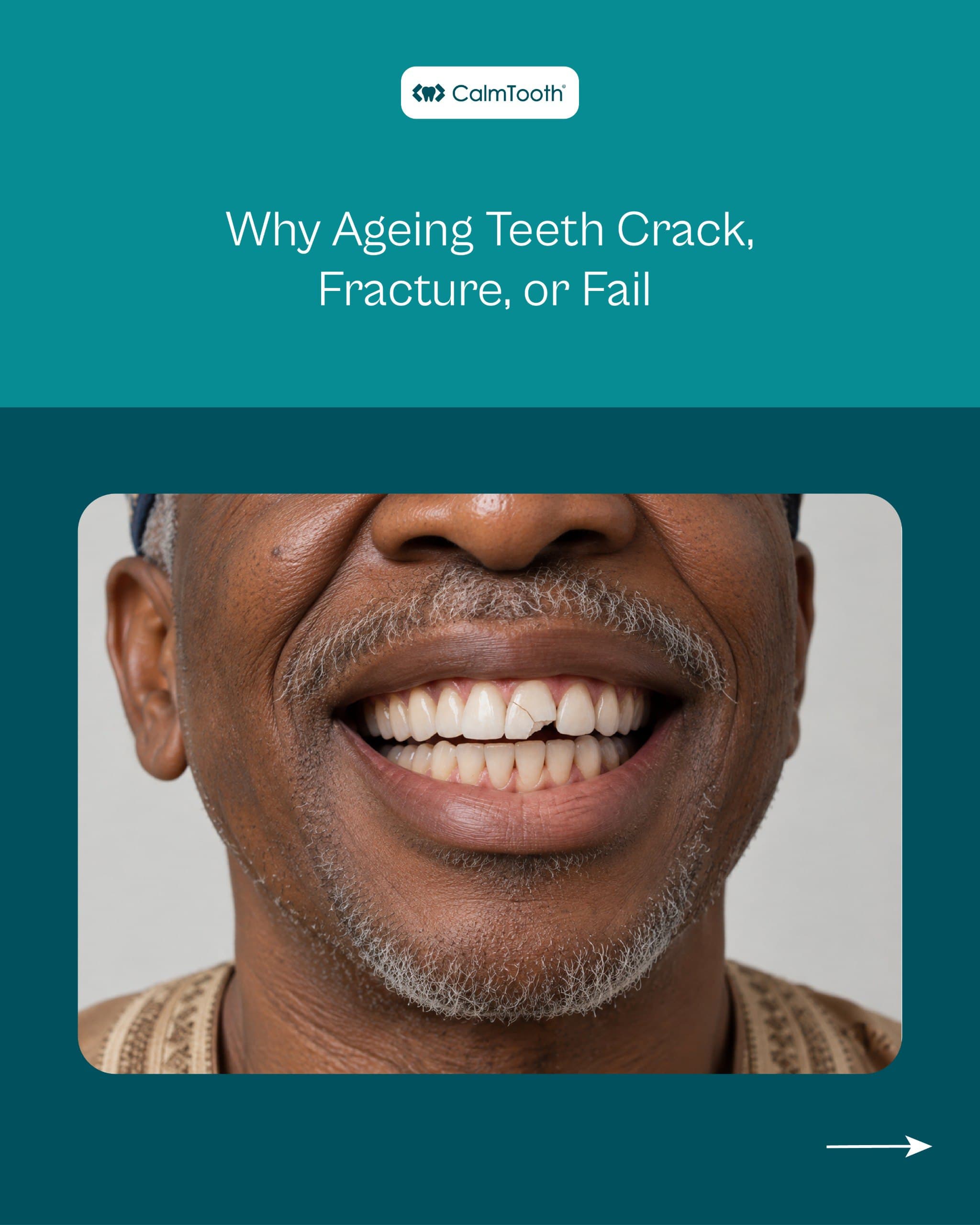
Why Ageing Teeth Crack, Fracture, or Fail (and How to Protect Them)
Medically reviewed by Dr Dan
Teeth don’t wear out on a fixed schedule, but by your 40s and 50s, decades of chewing, old dental work, and thinner, more brittle enamel make cracks and fractures far more common and far easier to prevent than most people realize.The tricky part: the crack that eventually breaks a tooth in half often starts years earlier as something too small to feel, and it usually won’t show up on an X-ray until it’s already a problem.
What You’re Feeling vs. What It Likely Means
What You’re Feeling:
A rough or catching edge, no pain
What It Likely Means:
A harmless craze line, surface-only crack
What You’re Feeling:
Sharp pain on biting down, then it’s gone
What It Likely Means:
Possible cracked tooth syndrome, worth checking soon
What You’re Feeling:
A tooth with a large filling or root canal, no crown
What It Likely Means:
Already at higher fracture risk
What You’re Feeling:
Constant ache, swelling, or pain with heat
What It Likely Means:
The crack may have reached the nerve, don’t wait
Why This Happens
By your 40s, teeth have absorbed decades of chewing, temperature swings, and often a filling or two. Dentin loses elasticity and enamel thins with age, so it takes less force to start a crack. Cracked tooth syndrome is most common in people over 40, and research published in the Journal of the American Dental Association has found some degree of cracking in roughly 80% of patients over 40. Teeth with large fillings or root canals but no protective crown are especially vulnerable, since removing decay also removes the structure that once held the tooth together.
Grinding adds more load: in one large study of older adults, over half of those who answered reported grinding their teeth. Dry mouth compounds it further, affecting an estimated 30% of adults over 65 and up to 40% over 80, per the ADA, usually as a medication side effect, stripping away saliva’s natural protection against everyday wear.
How to Protect Aging Teeth
- Get a nightguard if you grind. It’s the single biggest fix for grinding-related cracks, and it’s a one-time fitting.
- Cap heavily filled or root-canaled teeth. A crown redistributes biting force the way natural enamel used to.
- Skip the ice and hard candy. Cracks from biting hard foods are common, and completely avoidable.
- Flag dry mouth to your dentist, especially if you’re on multiple medications, a rinse or saliva substitute can help restore some protection.
- Don’t ignore a fleeting, sharp bite-down pain. Cracked tooth syndrome is easy to treat early, and much harder to fix once it reaches the nerve.
FAQs
Can a cracked tooth heal on its own?
No. Unlike a bone, a tooth can’t repair itself. A crown or other restoration is what stops a crack from spreading further.
Is a craze line ever something to worry about?
Rarely. Craze lines stay in the outer enamel and usually just need watching, not treatment.